July 15, 2021
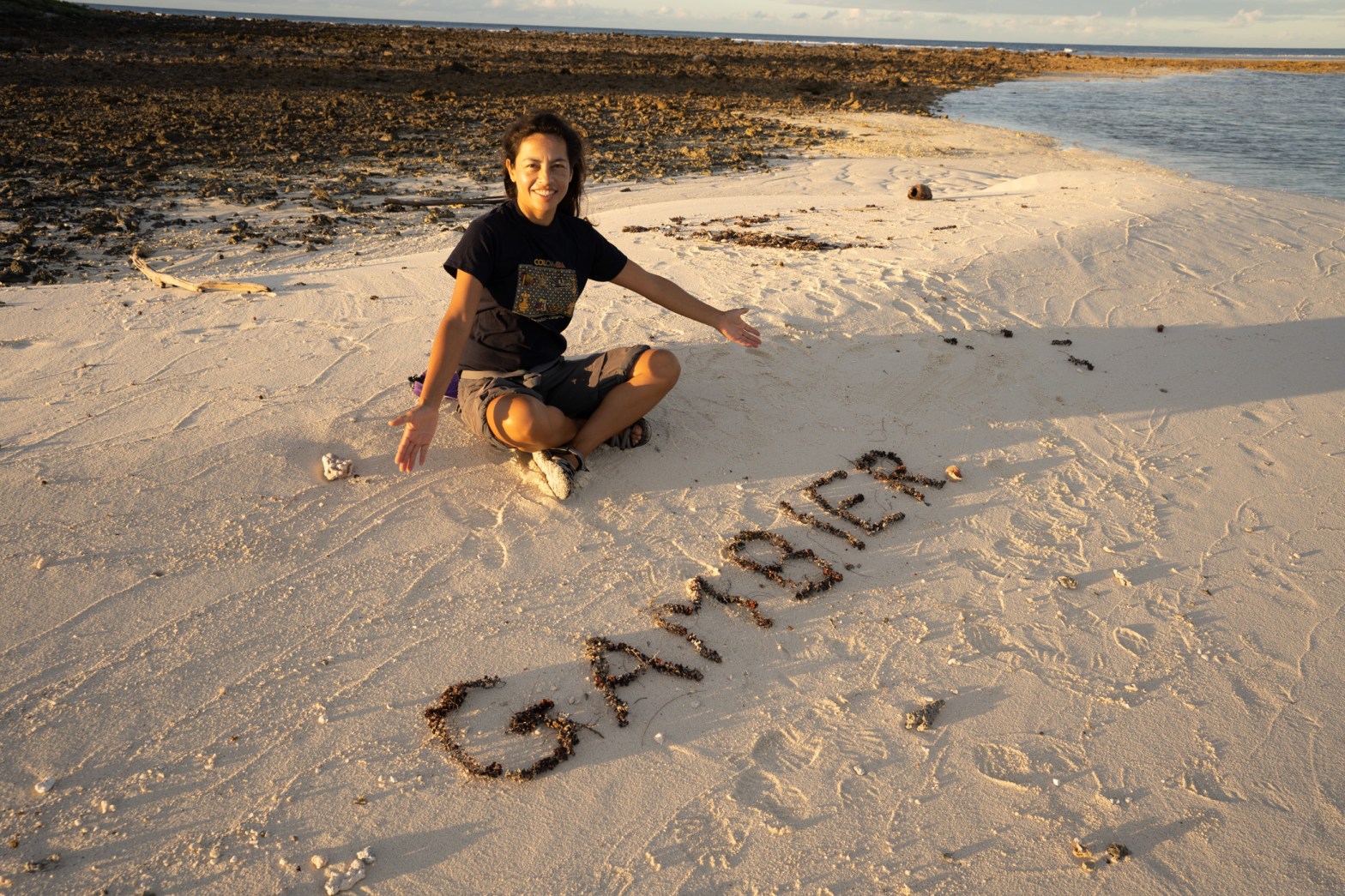
You probably have not hear about this place before. I think even French people doesn’t know about Mangareva, Rikitea, Gambier Islands so let me quickly explain. French Polynesia is an overseas French territory it is comprised of 4 groups of Islands, 5 if you count Gambier as an extra group. The four groups are: Austral Islands, Society Islands, Marquises Islands and the Toamotu Archipelago. Gambier is normally included in the Toamotus. All together they covered and area by 4100 square kilometres with 118 islands, atolls and motus. The most known islands are Tahiti and Bora Bora which are part of the Society Island.
118 Islands and 300.000 habitants, 69% of them in Tahiti. So the rest is not very populated. Which explains why we were so close to the arrival and we could not see a glimpse of light. It is because there are only about 600 people in Rikitea. There are 1000 registered there but many do not stay there permanently.
We arrived to Rikitea on a Sunday, made our papers on Monday and were free to go and start exploring straight away.
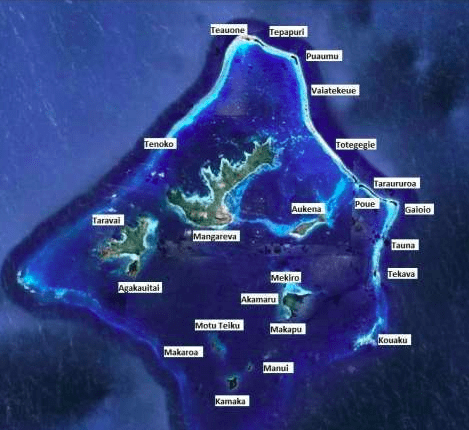
Aa per the picture above, there is all that to discover, multiples islands inside the atoll, mountains with lots of walks, beaches, motus and a lot more. We spend almost 2 months in Gambier, really a remote and beautiful place where the tourism is almost inexistent. I thought after 22 days at sea I could find a hotel to take a few days and relax, but I only found 2 pensions which looked very basic. With a flat anchorage, it was better to stay on happy days.
We visited everywhere we could think off, met locals and boaties, swam with sharks, hike, dance and lots more. Very difficult to write it all but I’ll tell you about some of the highlights.
Surprising facts
- To bring some perspective, this is France and there is no “boulangerie” in the whole place. There is one “boulanger” that makes baguettes and you have to buy them before 5am otherwise they are gone. But during our stay, he simply forgot to order flour, nothing else nothing more that forgot the flour …. I believe he was looking for 4 weeks of holidays.
- Manicure gardens. It is incredible the amount of time an effort that everyone puts in maintaining their garden. They cut, clean, dispose all the dry leaves. It is like their signature. It is a pleasure to walk around and see them.
- Legumes are super expensive and rare. While fruits are abundant and free. Not many people grow vegetables, it takes time and effort and they do not have time. The main activity is the pearl. Therefore most people work in the pearl farms. If they cultivate is only enough for their family so nothing is available in the supermarket. The boat with supplies comes once a month and the day after it arrives everything is gone by 6am. On the contrary, fruit trees grow everywhere so grapefruits, lemons, bananas and more were there available and offered to us all the time.
TOTEGEGIE and the motus
This is the anchorage close to the airport. Mangareva which is the biggest island in the archipelago has no place for an airport. So the airport was built on the lagoon edge. A long strip of land, flat perfect. So on one side is the outer sea and the other side is the lagoon. You can see Totegeige in the map above.
We anchored in between 10 and 20m. It is tricky as the depth varies very quickly. There are a few coral heads all around and the charts are not very accurate. With pristine water and a good sun at noon, the turquoise sea with darker spots is just amazing. On this side of the lagoon, we could have perfect sunsets.
A very nice snorkeling ground around is the northern pass. This pass is barely a gap in the coral. Small fishing vessel would pass through but happy days would not fit as it is quite shallow. The current can get a bit strong so we had to swim going out and just ¨fly¨back. Sharks are easy to spot, there was a group of lemon sharks, a handful of black tip although this ones have a brown body and also a couple of white tip. Fish are nicely big in the area. Unfortunately, there is ciguatera in the lagoon. As they dońt get fished, napoleon, grouper, parrot fish can be over a meter long.
After we went to visit the three motus on the north. The sail there was not supposed to be very long, it was a beautiful bright day. The only problem we were going in an area where the map says: “Not sureveyed”. That’s like walking blind for us. Nevertheless, I went in the bow to look for any dangers. If I spot anything I can shout to Cedric, so he can stop the engine or change course, before the keel reach the obstacle. Therefore, at low speed it could be enough to avoid the obstacle. The problem was that with clear water and perfect lighting the coral that seats at 10m depth, looks to me like at 2m. We kept going slowly and looking out waving around coral heads. But another obstacle showed up. There are a lot of pearl farms in Gambier, so many that I’ll explain in more detail in another chapter below. But for this chapter the important thing to understand is that the pearl farms installed buoys every 50m meters attached by lines that should be at 4m depth. Obviously those are not in the charts, they constantly change and they can be anywhere.
Four meters should be no problem, but this time I’m sure it wasn’t. We were going slowly with the engine, I was looking for coral heads when suddenly I see we are almost on top of one of those lines. The buoy attached to it was submerge so I couldn’t see it. I screamed as loud as I could, Cedric stopped the engine but with our inertia we keep going and passed on top of the line. A miracle we didn’t get caught. One of those lines in the engine can cause some serious trouble.
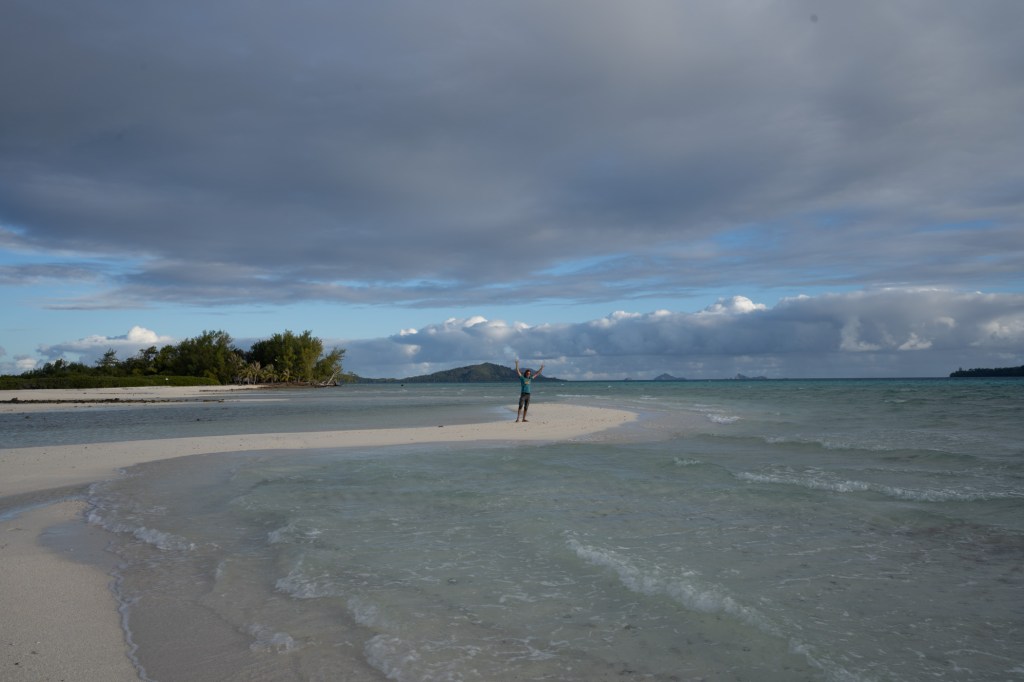
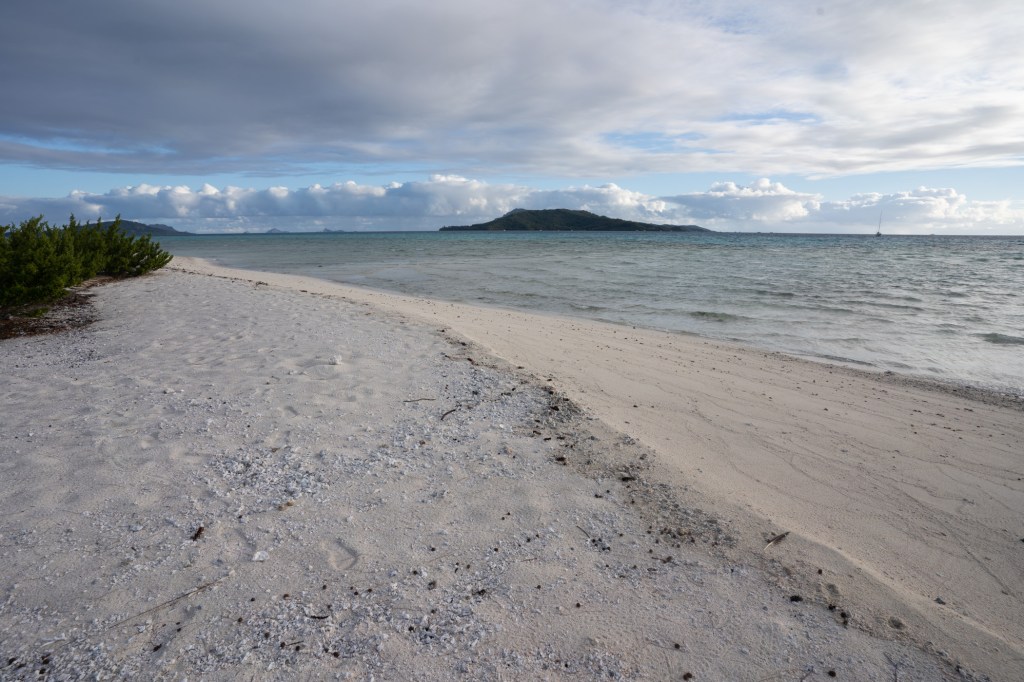
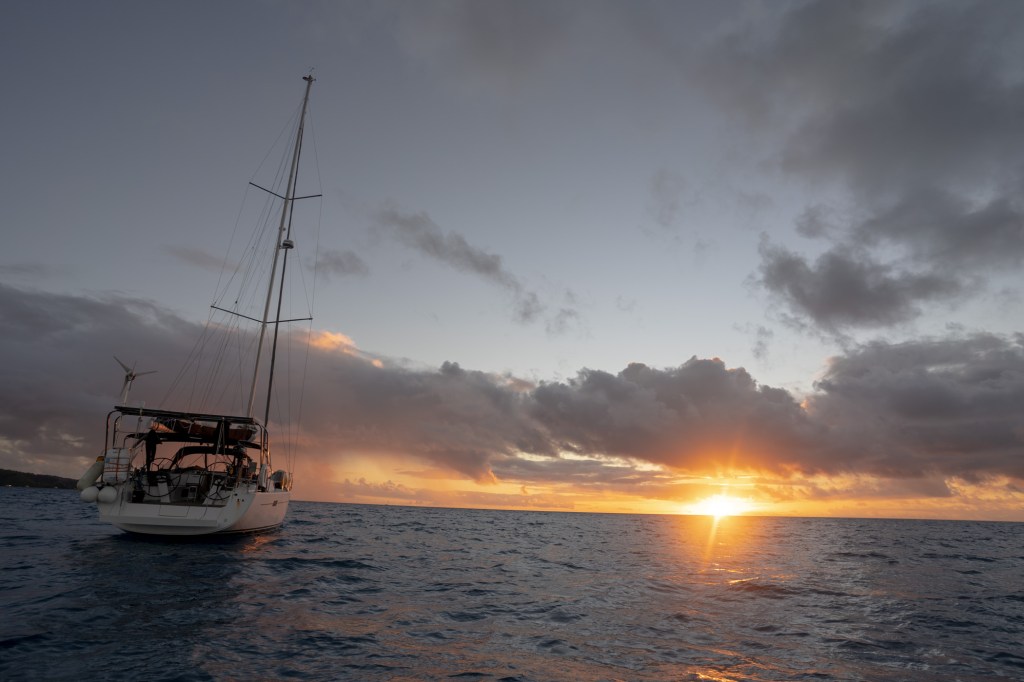
We turned around and went closer in front one of the motus and anchored in between coral heads. It was not ideal but there was not much choice. We had enough time to go for walk on the motu and enjoy the beautiful landscape. Before the skies when dark and we had grey sky and rain. It resulted in a great sunset.
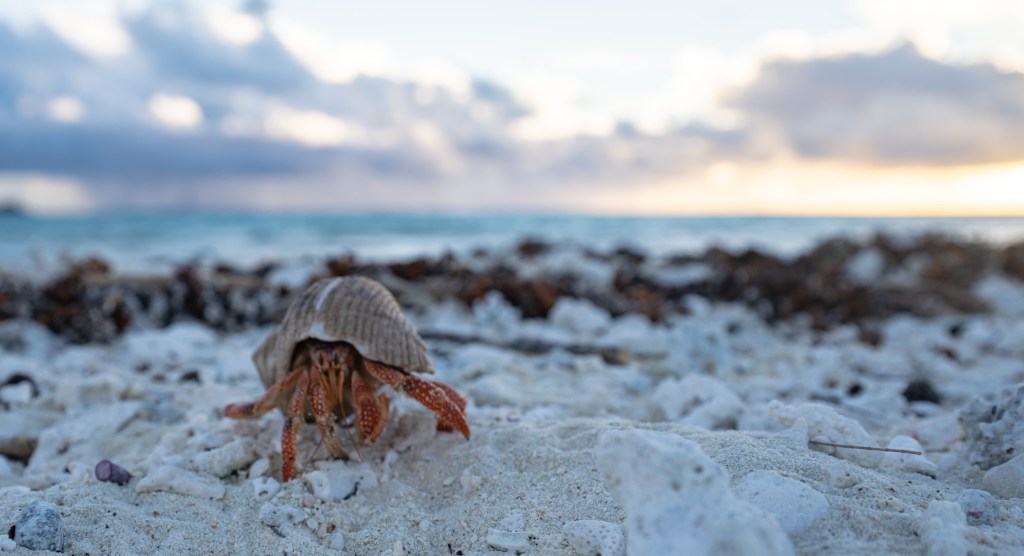
and the sunset
Pearls, pearls and more pearls.
You probably have seen or heard about the famous Tahitian grey pearls. Well, let me tell you that most Tahitian pearls come from Gambier or Toamotu and the most rare and expensive ones are not the grey ones but the colour ones. They come in pink, aubergine, purple, blue and more. They come in different shapes, sizes and shine.
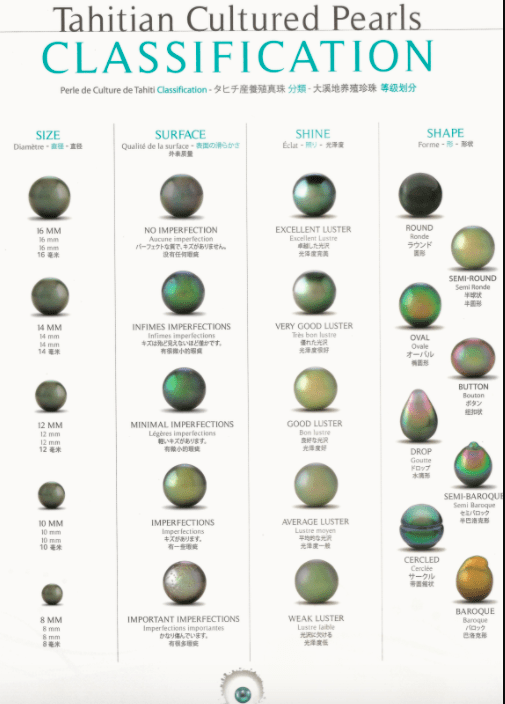
We asked around and visited the jewerlries on Mangareva, We were very lucky to meet Claude. He is a perlicultor, who started his business at a young age and he now runs a big pearl farm. We asked him if it was possible to visit and he immediately said yes. We agreed on the date and a couple of other boats in the bay came along.
The process of producing a pearl takes years and it explain in the table below.
1 – La ressource
The Tahitian pearl is grown exclusively in the Polynesian lagoons, in the black-lipped oyster, otherwise known as Pinctada Margaritifera. This name designates both the treasure and the pearl. It is exceedingly fragile and lives only in a few Pacific lagoons. This mollusk has the ability to reproduce easily on a regular basis especially in intersaisons.
2 – Spat collecting
During the spawning period of the oysters, collectors are installed in the lagoon to allow the male and female gametes to mix in order to give birth to larvae of nacres called spat. These collectors are pieces of black plastic attached to ropes. This makes it possible to capture the larvae of the mother-of-pearl so that they cling and grow.
Once the spat is collected, the removal operation begins. This involves removing the larvae (spat) from the collectors. The spat is then pierced and suspended by a nylon thread with strings called beads that will support 10 to 20 oysters. This thread allows to recreate the link that united the spat to its collector.
3 – Breeding
The rearing of Pinctada Margaritifera oysters requires optimal monitoring both for their health and for their protection against natural predators.
To promote their growth, regular and thorough cleaning is essential. Two to four times a year, the oysters are removed from the water to be thoroughly cleaned (high pressure cleaner). This work consists of removing all the shells, molluscs and algae that stick to them and that disturb the good development of the oyster.
It is only after three years that the oysters can be grafted.
4 – Grafting
To obtain a Tahitian cultured pearl, it is necessary to proceed to the grafting stage. This involves making a small incision in the pearl pocket to insert a graft and a nucleus.
graft: piece of mantle taken from a donor oyster
nucleus: ball from a piece of shell
Following the operation, a period of 45 days is required to determine whether there has been a release of the nucleus or the death of the oyster. If, on the contrary, the nucleus and the graft are accepted by the oyster carrier, the latter will produce for 24 months a layer of mother-of-pearl to protect itself. The mother-of-pearl must reach a minimum thickness of 0.8 mm before it can be marketed.
From time to time, when the oyster rejects the nucleus, the Keshi is formed with the small piece of graft. Unlike the pearl, the Keshi does not contain a spherical core.
5 – Harvesting
After two long years, the pearl farmers take out the oysters carrying the water and again call on the grafters to harvest the pearls.
Once the oysters are cleaned, the grafter makes a second incision to take out the pearl or the Keshi (pearl without core). If the mother oyster is healthy and the grafter judges the quality of the harvested pearls satisfactory, the oyster is grafted again (surgraft) with a nucleus of the same size.
If the pearl is not satisfactory, the process is stopped and the mother-of-pearl will be used in handicrafts or in the design of decorative object etc.
Once harvested, the pearls and keshis are rinsed and then put into a drum to clean and shine.
On our visit we had the opportunity to see parts of the process the cleaning as part of the breading and the grafting. The harvesting was planned for late July, so too late for us to stay and see it.
Anyway we had a full morning visiting the pearl farm, learning about the process and “helping” the crew.
Here is a video, we had a chance to see the breeding and the grafting. And later Claude let me choose a few pearls from his stock!! truly amazing
Spanish class
One day we were talking in Spanish while we were walking in town. It was the time when kids go out of school. A bunch of boys approached us and started speaking a few words in Spanish. “hola, como estas”, “si, si, hablo español..”. I was very surprised when they start talking Spanish. After we change to french and they told us they have Spanish at school and it was clear a couple of them had a little understanding.
The town is small, so if you stay long enough you end up recognising the faces of everybody and between them they all know each other. There are big families so people one way or another are all related (And thius is without counting on Famoo – the adoption system in polynesia). We heard from some youth that they have to go to other islands to meet a partner otherwise they are all related.
We were in town for a couple of weeks already, when one day the same bunch of kids we meet before stopped us to talk Spanish again. They told us they had a day at school about languages and that they would like for us to go to the school and share the day with them. I asked if they wanted for us to prepared anything, but they said they just wanted us to come and talk Spanish.
We arrived to the school and met the Spanish/English teacher who explained to us the activity. The school is just by the sea, with a scenery like this I think anyone will be motivated to go everyday.
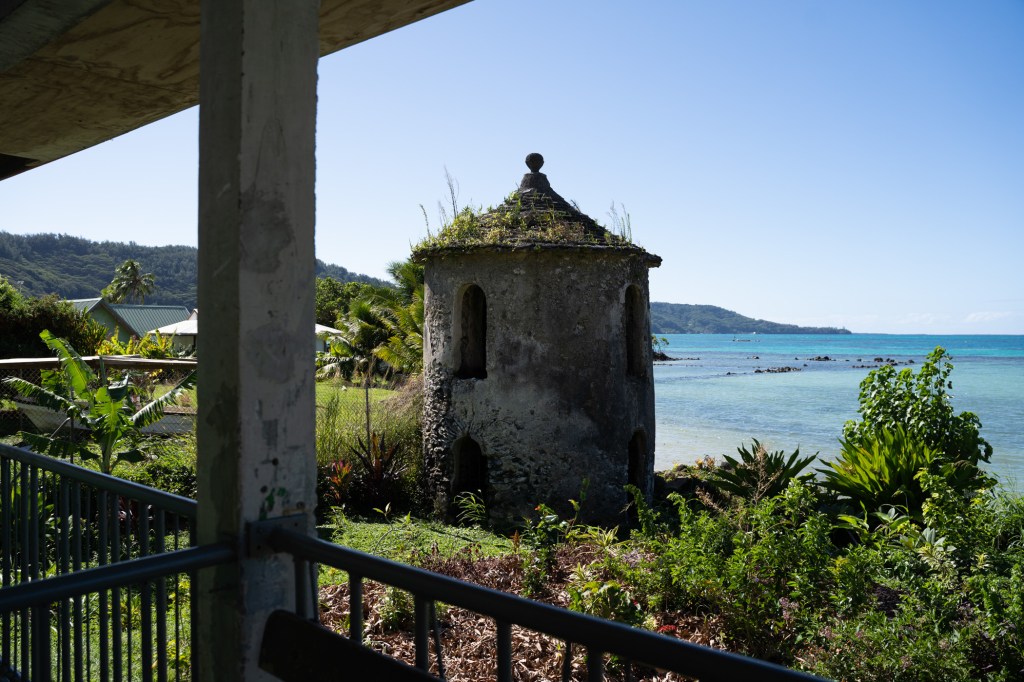
They had been divided in groups and each group had a different topic prepared.
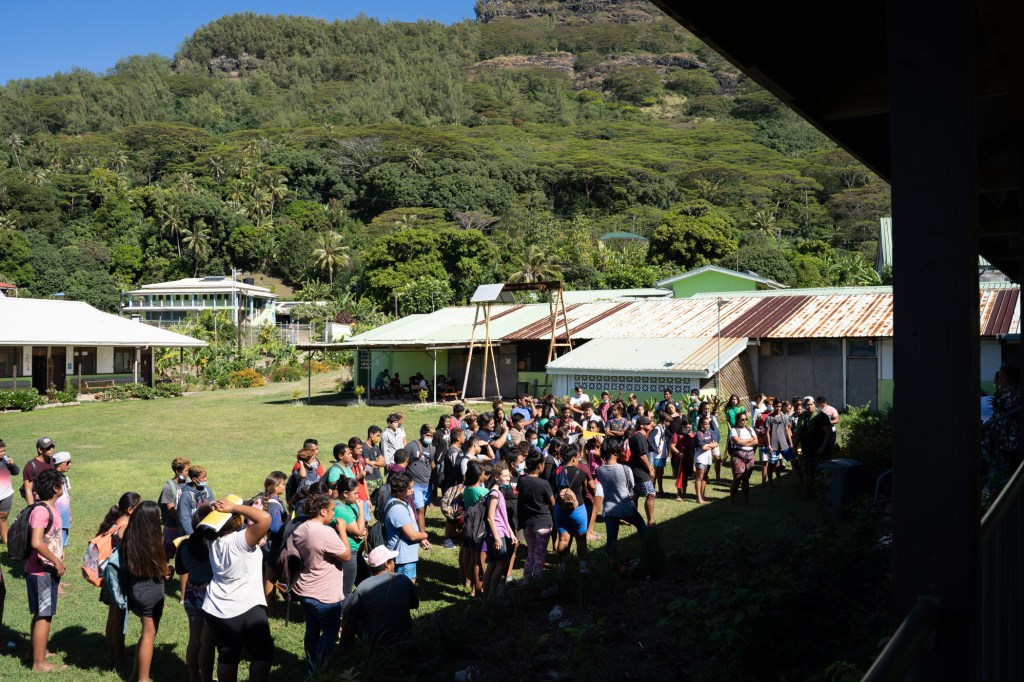
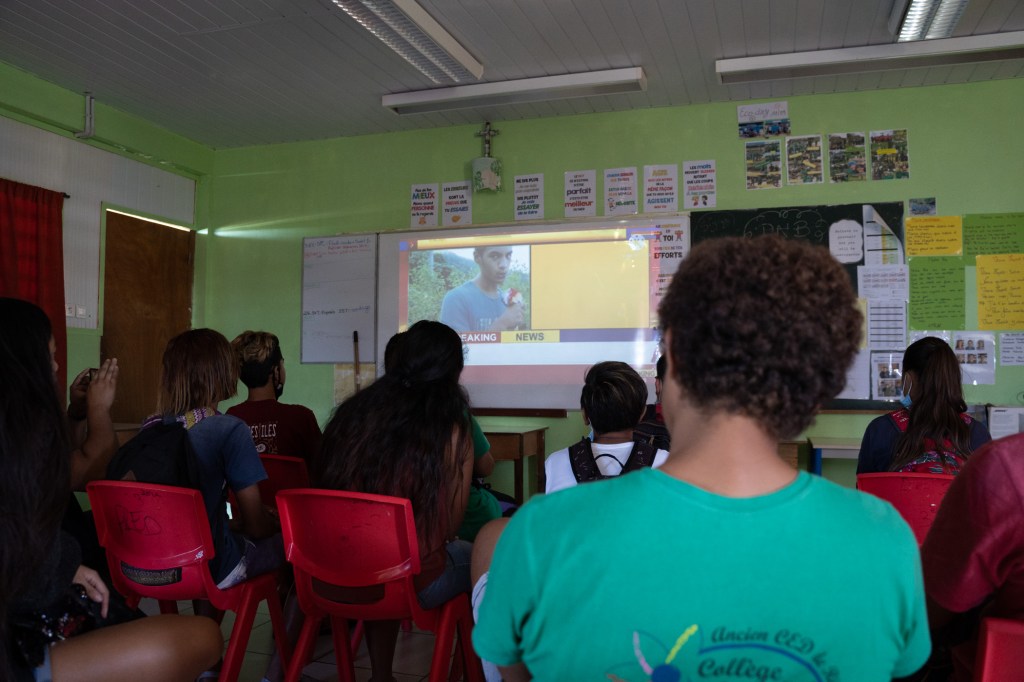
Some had prepared video clips, we watch one of them. I was suprised by the quality and the ideas in it. Remembered, this is a very remote place, they don’t have that much, everything is expensive and takes long time to get there. But they are still young minds with lots of creativity.
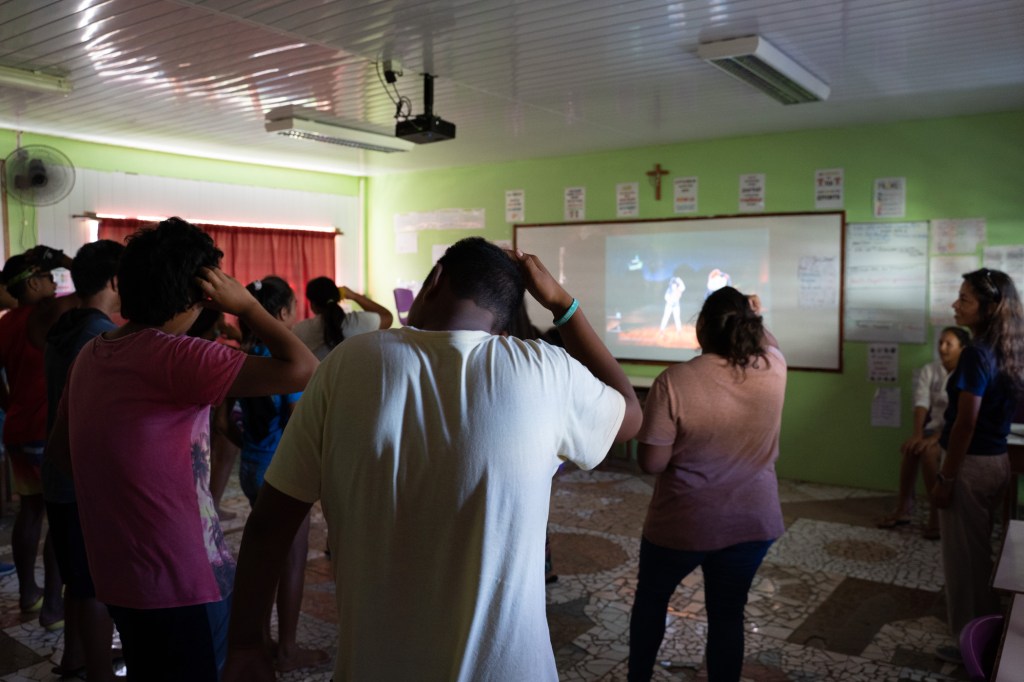
The dancing was my favourite, I helped the girls doing the presentation to present the activity in Spanish. They were in level one, I think, so less fluent. But definitely my favourite activity, they get videos from a videogame, in Spanish and everybody signs and follow the steps.
It was a great afternoon, I was pleasantly surprised with the level of Spanish they had. Great experience to share sometime with those young curious minds. They asked a lot of questions.
Dancing
In Gambier the traditional festival normally falls in July. It is full of activities and one of the main attractions is the typical dance. One night we were out for a walk and could hear the drums, we had to check it out. It was a group of dancers on rehearsal. We stayed and watch until the end of the practice but didn’t really know what it was about. Few days later we found out they were preparing for the Heva.
Heva is the traditional Polynesian festival every year in July.
One day we were talking to Marie-Ange who is French originally but has been living in Polynesia for the last 20 years, she now leaves in one of the boats that we meet in the anchorage. She mentioned that she was part of the dance group and that they were rehearsing once a week to prepare for the July festivities. I asked her if she if it was possible for me to join the group. The next day, I went to the practice, she asked Dany, the director and choreograph, who was happy for me to join.
From there on I was dancing twice a week, then 3 times a week and then everyday as July was getting closer. We practiced different routines and types of dance.
The traditional dance of gambier is called “Le Pei” . It seems a lot easier that it actually is and I was definitely on disadvantage all locals learn to dance when they are kids. The main steps are repeated in the different choreographies prepared by Dany. The main one was a legend about how two tribes from different Islands Taravai and Tapu. In the legend the Tapu kidnaped the princes of Taravai, killed her and proceed to eat her (graphically displayed in the dance).
The other dances were Aparimas, they required a lot more practice from my side, because the movements that are just natural to the locals are a big work for me. Cedric would go to the rehearsal and film the entire choreography. Like this I could practice with the video. Hours and Hours of practice.
On June 15 Dany revealed official dates for the Heva, 9, 16 and 22 of July. With those dates it was almost sure I would not be there for the show. Which I was a bit disappointed but we needed to keep going. August 23, I should be back in Australia to go back to work.
Anyway, one night on the practice Dany arrives and told us he was asked to give a private presentation on June 24. That was excellent because I really wanted to be part of the show. The whole experience was amazing and a lot of work. Dany didn’t want to reveal the choreography we had been practicing. So we had to prepared another one.
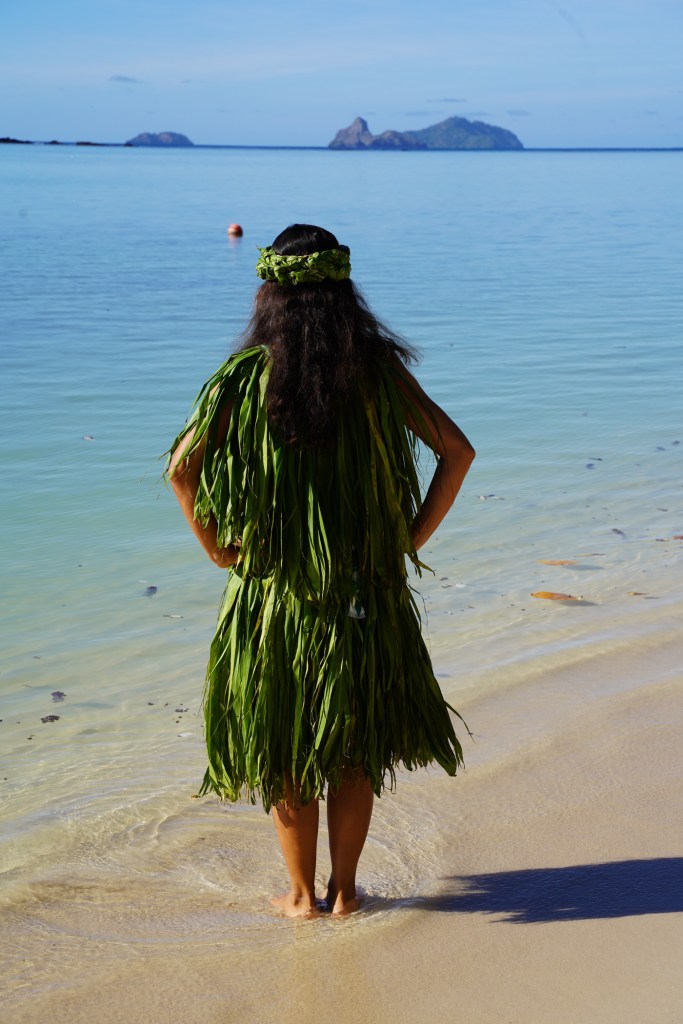
The date arrived quickly, I had to train plenty and the day before we had to make our own costume. I was a bit worried because he said the dress would be only vegetal, no make up, no jewels, “just natural and only vegetal”- Dany told us. I couldn’t picture it at all and I was wondering how the “only vegetal dress” will stay in place with all the moves we were doing. Therefore, the day before we had to go collect the Aouti leaves. Aouti is a sacred tree that easily grows in Gambier, almost everyone have Aoutis in their house or knew places to get it. I was told I could go close to the cemetery and over there I would find plenty. So there I was early morning collecting the leaves for my dress. I need it at leas 100 so it was two big garbage bags full and heavy.
Marie-Ange who has done already the dance a year before told me we could meet in the morning to start preparing the leaves and in the afternoon we would meet with the rest of the group to make the skirt and top. The preparation of the leaves is important, they have to be the same size, same colour and the nerve has to be remove very carefully not to damage the leave. The whole process of making the costumes is an art in itself which takes a long time but it is all worth it when the group is all together and dancing at the same rhythm the leaves just make and extra movement and sound that makes it so vibrant and lively.
I put together a sequence with a bit of the training and the preparation of the outfit. Look at the video.
After all the training hours, including my private training because remember I had to practice alone to catch up, the final presentation day came. We were basically the dance group making the entertainment on a private party for a 90 year old politician born in Gambier, the ex-president of Polynesia.
We got to the pension for the reception and the evening was definitely a big highlight for us in Gambier. I was part of the dance troop and Cedric sneaked in as the photographer. The invitations were reserved but after all the training and costume preparation we definitely didn’t want Cedric to missed the show.
Our performance was very acclaimed by the guest. At the end, we also improvised by inviting the guess to dance which was very well received. Dany, our Dance troop director and choreograph was profusely congratulated leaving with multiple bottles of champagne we had to take care off with him.
Look at the video and see if you can spot me!!
After the dance, some of the team left but we ended up staying with Dany and became guess of the party. At the end we were a group of about 10, including Dany, the DJ (director of the college), Marie-Ange and few more. We then moved to the afterparty. Probably our first after party since COVID started.
The afterparty was hilarious, two pickups with a fridge full of drinks and loud radio. We were park just in front of the anchorage. Now it made sense to me, why sometimes at night I could hear loud music. Well it is simple, the after parties are at the quay just in front of our anchorage.
I have enough stories for another full post but internet is almost inexistent, so I will post more later. But if you like pictures… have a look. (click here)
 Happy Days
Me encanta tu vestido, esta fantástico el proceso de las perlas, aprendi muchísimo, gracias por compartir.
Que bonito tu capitan ayudando con las hojas. Abrazos, Marceli
LikeLiked by 1 person